
Understanding Grief
Grief is a natural response to losing someone or something meaningful to you. It’s often characterised by a mix of overwhelming and confusing emotions that can be difficult to express. One moment, you might find yourself smiling at a fond memory, while the next, an intense wave of sadness catches you off guard.
We often associate grief with bereavement - the profound sense of loss that follows the death of a loved one. However, grief can arise from many different types of loss. This loss may be visible to those around us. Other times, it may be less recognised or understood by others.
Examples of loss that can cause grief include:
The death of a loved one, such as a family member, friend, or a pet.
The end of a friendship or relationship.
Divorce or separation.
Miscarriage or infertility.
The loss of a job or retirement.
The loss of safety following a traumatic event.
A life-changing illness or injury.
Changes in the health of a loved one.
Major life changes, such as children leaving the family home.
The loss of a future you hoped for.
Grief is therefore something that many of us will experience at some point in our lives. Whatever the nature of the loss, it can trigger a range of difficult emotions. Taking the time to recognise and make sense of these feelings can represent an important step towards finding ways to cope and support us on our journey to healing.
How Grief Can Affect Us
When we think about grief, we often focus on the sadness that can accompany a loss. However, grief can affect many aspects of our lives, including our emotions, thoughts, relationships, and physical health.
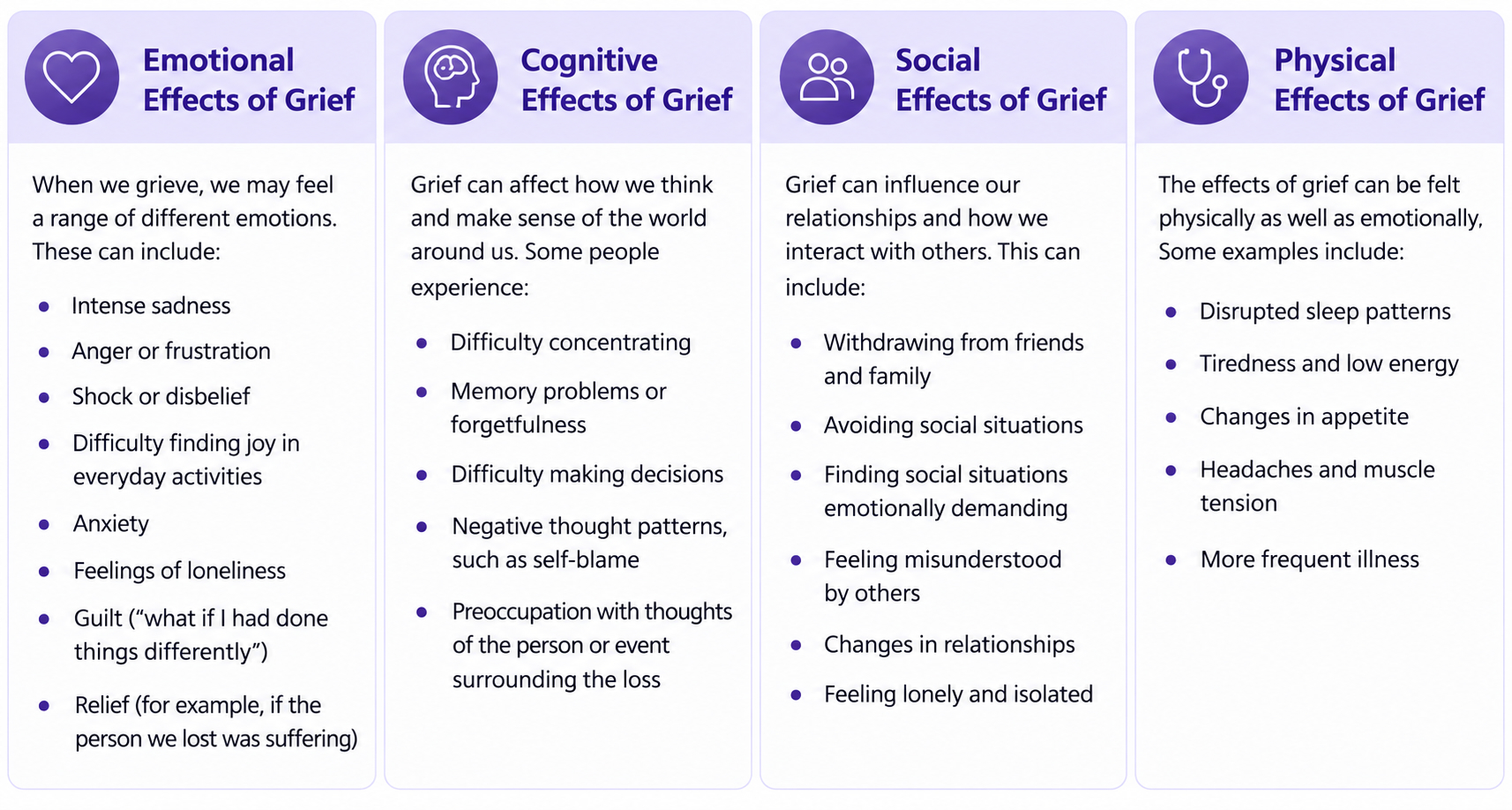
You may experience many of these effects, or respond in a different way. Grief is deeply personal, and there is no “right” or “wrong” way to experience it.
The Grieving Process
The Five Stages of Grief
In 1969, psychiatrist Elisabeth Kübler-Ross identified five emotional responses seen in people facing terminal illness. These became known as the Five Stages of Grief, and have since been used more broadly to describe how people may experience grief and loss:
Denial
During denial, the reality of the loss may feel unreal or too much to bear. You may feel numb, carry on as if nothing has happened, or want to distance yourself from the people who have acknowledged the loss. You might think, “this isn’t real” or “this can’t be happening to me”.
Anger
Anger involves feeling frustrated or resentful about the loss. This anger may be directed towards the situation, others, the person you’ve lost, or yourself. You might think, “this isn’t fair” or “why me?”
Bargaining
During bargaining, you may find yourself dwelling on “what if” or “if only” thoughts, imagining how things could have turned out if you had made different choices. This can stem from a desire to reverse the loss.
Depression
Depression can involve feelings of intense sorrow, emptiness, or despair as the reality of the loss sinks in. You might experience a sense of hopelessness and find yourself thinking, “I don’t know how to move forwards”.
Acceptance
Acceptance involves gradually coming to terms with the reality of the loss. This means learning how to live with the loss while keeping the memories of what you have lost close to you. This does not mean that the pain goes away or that the grieving process is over.
The Five Stages of Grief are in no way a checklist you need to work through, nor do they follow a set order. You may have heard someone say something like, “I’m moving from denial to anger” or “I wonder when I'll reach acceptance”. However, grief is an individual journey - many people will experience some of these stages, several at once, or none at all.
The idea of this model is that there are some emotions that many of us will share. Taking the time to name and understand these feelings using this framework can help us feel a sense of clarity and understanding, while reminding us that we are not alone in what we are going through.
The Dual Process Model
The grieving process can feel unpredictable. One minute, you feel okay. The next, a song plays on the radio, you catch a glimpse of a photograph, or you smell a particular scent that brings a flood of emotions back to the surface.
We often think grief is something we need to move through or “recover” from within a specific timeframe. However, grief does not follow a straight line, and difficult emotions can resurface unexpectedly even as you gradually begin to adjust to life after a loss.
The Dual Process Model, introduced by researchers Margaret Stroebe and Hank Schut in 1999, can help us understand this experience more clearly.
The basic idea of this model is that we move back and forth between two areas of coping after a loss. These are known as:
Loss-oriented stressors: These focus on the emotional impact of the loss itself. This might look like looking through old photographs, visiting a gravestone or memorial, missing someone deeply, or yearning for what life once looked like.
Restoration-oriented stressors: These involve adjusting to life after a loss and managing the changes it brings. This might mean taking on a new role or responsibility, forming new relationships, or working towards a personal goal.
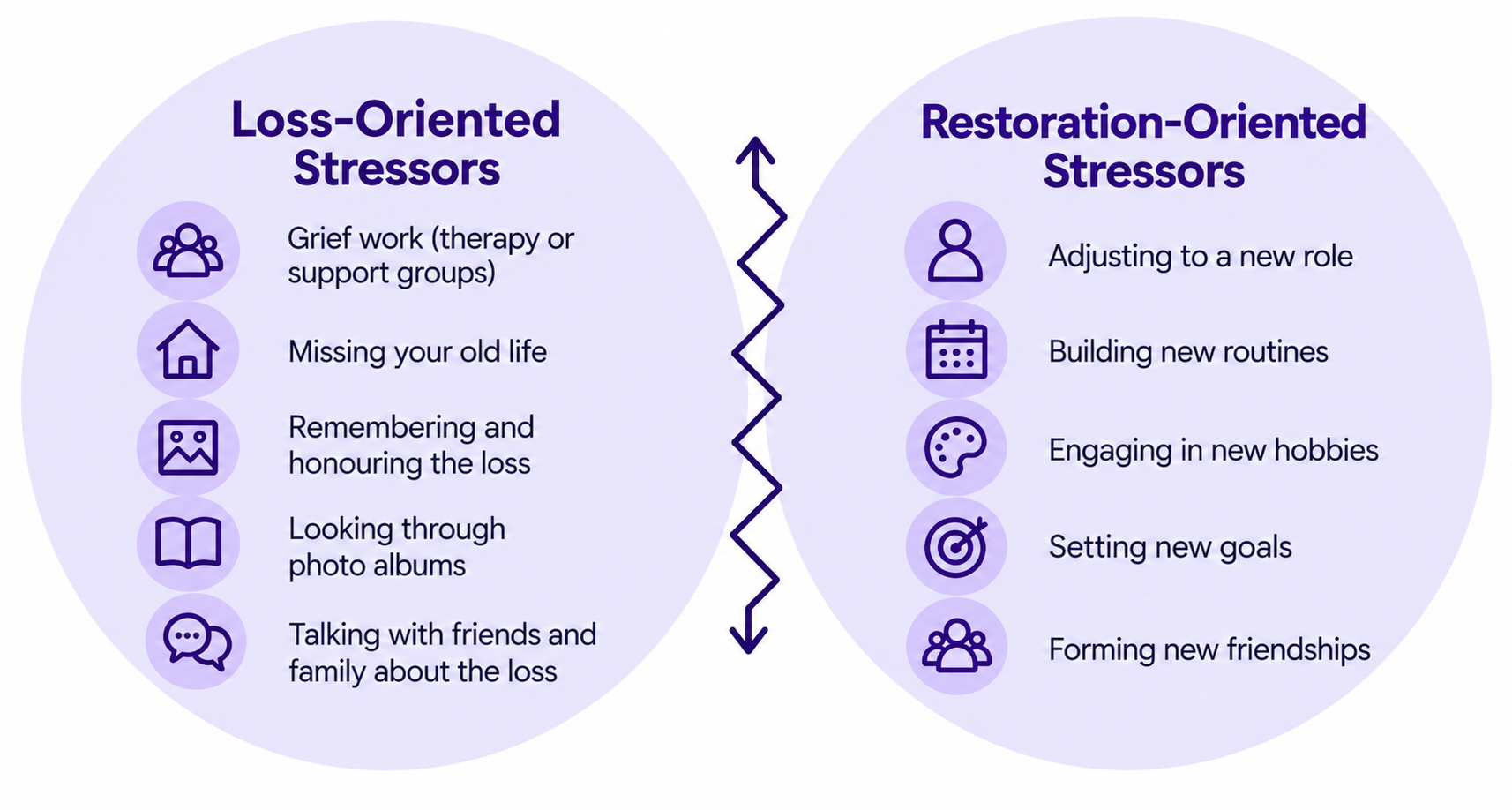
This model emphasises that it is normal to shift back and forth between loss-oriented and restoration-oriented stressors. In other words, there may be moments when you focus on the loss and the feelings that come with it. Other times, you may focus on the rebuilding of life that follows the loss.
Both are normal parts of the grieving process that can help us to heal.
The Dual Process model offers two particularly important messages:
It reminds us that it is okay to have good days and bad days. Feeling okay one moment and sad the next does not mean that you are grieving in the wrong way or taking a step backwards.
It normalises the importance of taking breaks. Finding distractions, spending time with others, or pursuing personal goals can offer a much-needed respite from the emotional impact of loss. It is okay to find moments of relief - it does not mean you have forgotten about your loss or that it matters any less to you.
Managing Grief
Navigating loss is one of life’s most challenging experiences, and knowing how to cope during the process is not easy. While everyone experiences grief differently, there are some steps we can all take to support ourselves through the process.
Acknowledge your feelings
Give yourself the time and permission you need to feel and understand the emotions that come with loss. Grief is a journey, and there is no rush to feel better before you are ready.
Spot your triggers
Anniversaries, holidays, or specific places associated with a loss can trigger some heavy emotions. Anticipating how these triggers might affect you and planning ahead can help you feel more prepared for these difficult days. This might mean spending the time with someone you trust or stepping back to give yourself space.
Talk through your feelings
Even when you're surrounded by others, grief can be isolating. Sharing how you’re feeling with a family member, friend, or colleague you trust can help you feel less alone in what you’re going through.
Let others help you
Carrying the weight of everything on your own can be emotionally and physically exhausting. Allow yourself to accept support from the people around you in ways that feel comfortable – whether this means asking for support with everyday tasks, accepting quiet company, or sharing memories of the people you love.
Look after your mental health
Grief can be unpredictable. Pay attention to how you are feeling and give yourself permission to slow down and step back when you need to. It is okay to take time away from work, set boundaries in relationships, or put a pause on big life changes.
When Therapy Can Help
Whether you find it hard to talk to someone you trust, feel the heavy weight of your loss daily, or just need a safe space to express what you're going through, therapy can offer many benefits to support us during the grieving process.
One of the main benefits of therapy is having a safe, confidential space to unpack your feelings. Whether you are navigating sadness, shock, or regret, therapy can help you make sense of these complex emotions in a structured and meaningful way.
Therapists with specialist knowledge in grief are also well-equipped to provide coping strategies and tools tailored to your specific needs and experiences. This might look like techniques to manage challenging emotions or practical ways to maintain your physical health.
Ultimately, therapy can be an important stepping stone for many people to process their loss and gently find a way forward.
References
Kübler-Ross, E. (1969). On Death and Dying. New York: Macmillan.
Stroebe, M., & Schut, H. (1999). The dual process model of coping with bereavement: rationale and description. Death Studies, 23(3), 197-224. doi: 10.1080/074811899201046.

Get matched with a trauma specialist
Five minutes now, a match usually within 24 hours.
No pressure, no deadline.